- +91 9311397211
- Toll Free no. : 1800 1200 76547
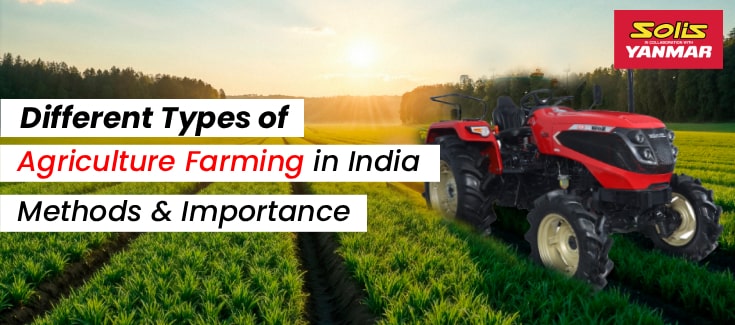
India is one of the world’s largest agricultural nations, with nearly 55% of the population depending on farming for income. Over the decades, different types of agriculture farming systems have evolved based on climate, soil, crop needs, and available resources.
But one thing remains common across all farming methods — the growing dependence on farm tractors. Today, tractors in agriculture have transformed productivity, reduced manual labour, and made modern farming more profitable for Indian farmers.
This blog explains the major types of farming in India, their importance, and the role of tractors in India’s agricultural growth.
Subsistence farming is widely practiced by small and marginal farmers where crops are grown mainly for family consumption.
Small landholding
Low investment
Basic tools and a small farm tractor for ploughing and sowing
Wheat, rice, pulses, vegetables
Helps small farmers complete field preparation faster
Mini tractors are ideal for small plots
Improves productivity with lower labour cost
Commercial farming aims at producing crops in large quantities for selling in the market.
Sugarcane, cotton, wheat, maize
Use of large farm tractors
Advanced implements like rotavators, seed drills, sprayers
Mechanised harvesting
Commercial farms rely heavily on the best tractor for farming to handle large workloads efficiently.
Plantation farming involves growing a single crop over large areas.
Tea, coffee, rubber, coconut, banana
Helps in transporting heavy loads
4WD tractors are useful in hilly plantation terrains
Supports orchard maintenance with compact tractor models
Mixed farming involves crop cultivation along with livestock farming.
Crops + dairy
Crops + poultry
Crops + fisheries
A multipurpose farm tractor manages both farming and livestock feed activities
Helps produce fodder crops using implements like:
Cultivator
Rotavator
Leveler
Dry farming is practiced in low-rainfall regions like Rajasthan, Maharashtra, and Karnataka.
Millets, pulses, groundnut, cotton
Deep ploughing with tractors helps conserve soil moisture
Implements like MB plough & cultivator are essential
4WD tractors perform better on dry, hard soil
Intensive farming aims for maximum production from limited land.
High-yield seeds
Mechanised operations
Fertilizer + irrigation systems
Save time
Increase productivity
Support large-scale operations
Ideal for fast ploughing, harrowing, sowing, spraying
Organic farming focuses on cultivation without chemical fertilizers or pesticides.
Bio-manure
Natural pest control
Crop rotation
Helps manage soil preparation efficiently
Implements like rotavator maintain soil health
Mini & medium HP tractors are widely used
The rapid expansion of tractors in agriculture is reshaping Indian farming.
Reduce labour cost
Save time during sowing & harvesting
Improve crop quality
Enable use of modern implements
Increase productivity & income
India’s mechanisation level reached ~48% in 2024, and is rising steadily
Tractor adoption has grown due to affordability, financing, and higher demand
4WD tractors and mini tractors are becoming more popular due to multi-purpose use
While the "best" tractor depends on land size and farming needs, farmers usually prefer:
4WD tractors for heavy work
Mini tractors for small farms & orchards
High-mileage tractors for longer operations
Solis tractors offer strong performance, high torque, and durability — making them a reliable choice for both small and large farmers.
Agriculture in India is diverse, and every farming type comes with its own challenges. But across all farming systems, tractors in agriculture have become the backbone of modern Indian farming. Whether it’s land preparation, sowing, transportation, or harvesting — a reliable farm tractor helps farmers boost productivity and earn better returns.
Ministry of Agriculture & Farmers Welfare Report 2024
FADA Tractor Sales Data 2024
ICAR Agricultural Mechanization Study
NSSO Agriculture Household Survey 2023
NABARD Farm Mechanization Report
India follows 6–7 major farming types including subsistence, commercial, mixed, plantation, intensive, dry, and organic farming.
Subsistence and mixed farming are the most common among small farmers.
Farm tractors reduce manual labour, save time, and increase productivity by supporting modern implements.
4WD tractors and 40–50 HP tractors are best for multi-purpose farming operations.
Millets, pulses, groundnut, cotton, and sorghum grow well in dry regions.

-1743137141.png)